


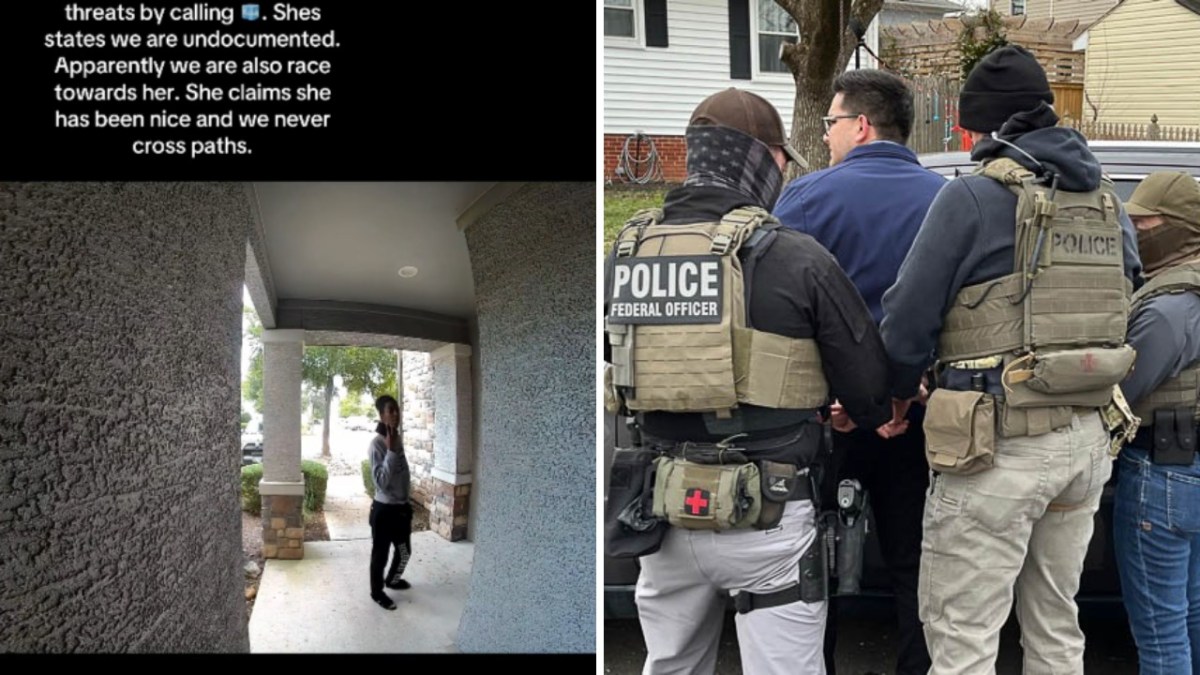

Outside a Texas apartment complex, a woman stands under a walkway with her phone to her ear, telling a dispatcher she wants to report unit 110 for blasting music at 5:49 p.m. She says the sound has jolted her and her two kids awake on multiple nights, and she first requests a wellness check on the people inside before pushing further. “Can you send an ICE agent? Because I think that they are undocumented as well,” she says, guessing that three separate families share the apartment.
According to The Nerd Stash, no music is audible anywhere in the 47-second TikTok video the outlet cited, shared by user @ozzybanks05, though the clip offers no way to confirm whether any had been playing before recording started. Text overlaid on the video, written by whoever posted it, states the family targeted by the call is Hispanic and says this is the first contact they’ve ever had with the woman, with no earlier word from her about any noise problem.
“We have never spoken to this lady before. We didn’t receive any communication on any noise complaints,” the text reads. The outlet reported that whoever posted the clip argued the woman had other options, like knocking on the door herself or checking with a different neighbor, before deciding instead to use the phone call to intimidate the household. None of this is independently verified beyond the video itself, and there’s no indication the woman was contacted for her side or declined to comment.
What a false report like this could mean legally
The number the woman describes as an “ICE hotline” is the Homeland Security Investigations Tip Line, which fields calls around the clock. Staffing on that line grew in 2025 as the agency worked to process immigration-related tips faster. Contrary to a claim that circulates online, ICE says no one is paid for information submitted through that tip line.
Whether a call like this carries legal consequences depends on what was actually said. Texas Penal Code Section 42.06, False Alarm or Report, makes it an offense to knowingly communicate a report of an emergency that the person knows is false. The report also has to be one that would ordinarily prompt a response from an emergency agency. That’s a Class A misdemeanor, carrying up to a year in jail and a $4,000 fine.
A separate statute, Section 37.08, False Report to Peace Officer, applies more narrowly. It covers a knowingly false statement made to an officer that is material to an actual criminal investigation. That offense is a Class B misdemeanor. Neither statute turns on whether the underlying claim about immigration status is true or false on its own. What matters is whether the person who called knew that the specific facts they reported, such as the noise complaint itself, were false.
Texas also allows enhanced penalties when a crime is proven to have been motivated by bias against a victim’s race or national origin. That enhancement comes from Penal Code Section 12.47 and the James Byrd Jr. Hate Crimes Act. It only attaches to an underlying offense already charged under specific parts of the Penal Code. It doesn’t create a standalone charge on its own. A phone call alone would need to first qualify as one of those covered offenses before bias could raise its severity.
No charges have been reported in connection with this incident.








Published: Sep 16, 2026 12:44 am