


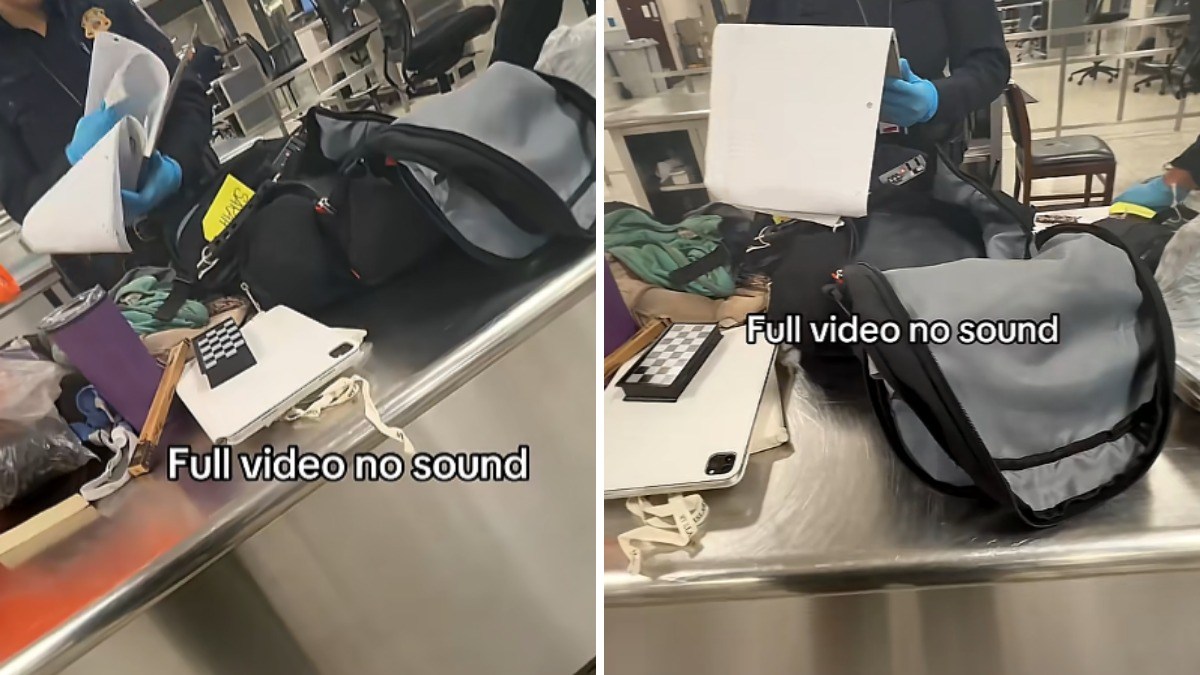

Sarah Awad was recording when a Transportation Security Administration (TSA) officer began turning the pages of her personal journal during a bag check. “Now you’re reading something I told you is confidential,” she tells the officer in the clip. Rather than let him linger on each page, she tells him to move through the book quickly.
Awad keeps challenging the officer on camera as the check drags on, and she requests a supervisor. “You can find your knife, find the drugs,” she says. “Like, find what you are trying to find.” Nothing in the footage establishes whether the officer turned up anything at all.
According to BroBible, the agency’s published screening guidance addresses electronics and food, with no mention anywhere of paging through what a traveler has written down. The outlet stated it emailed both Awad and the agency seeking comment.
A court already answered this exact question
Federal regulation defines the job narrowly. Under 49 CFR 1540.5, a screening function is the inspection of individuals and property for weapons, explosives, and incendiaries. That single definition is the legal foundation the entire checkpoint rests on.
The Fourth Amendment protects people in their “persons, houses, papers, and effects” against unreasonable searches. Checkpoints get around the warrant requirement through the administrative search doctrine, which permits searching everyone without suspicion when the goal is regulatory rather than catching criminals. The Ninth Circuit built a three-part test around that in United States v. Aukai in 2007.
A screening search has to stay “no more extensive or intensive than necessary” to find weapons or explosives, stay honestly confined to that purpose, and let a traveler walk away by choosing not to fly. Then came Jonathan Corbett. He sued over a checkpoint search and lost at the Eleventh Circuit, which held that thoroughly searching his bags was reasonable “even beyond the point of determining whether those belongings contained weapons.”
Corbett took it to the Supreme Court himself, without a lawyer, framing the question as whether screeners must stop at weapons or may read a traveler’s documents. The justices declined the case in 2015, according to the Identity Project, leaving that ruling in place. The practical result is a split. Travelers in the Ninth Circuit have the tighter weapons-only standard. Travelers in the Eleventh Circuit, covering Florida, Georgia and Alabama, fall under a rule that lets screeners look past weapons entirely.
The agency itself was created after the 9/11 attacks and sits within the Department of Homeland Security. Its authority stretches across aviation, along with rail, transit, highways, pipelines and ports. The screening mission stays tied to weapons, explosives and incendiaries, which is the narrow purpose that lets officers search a person without needing any reason to suspect them.










Published: Sep 14, 2026 02:15 pm