


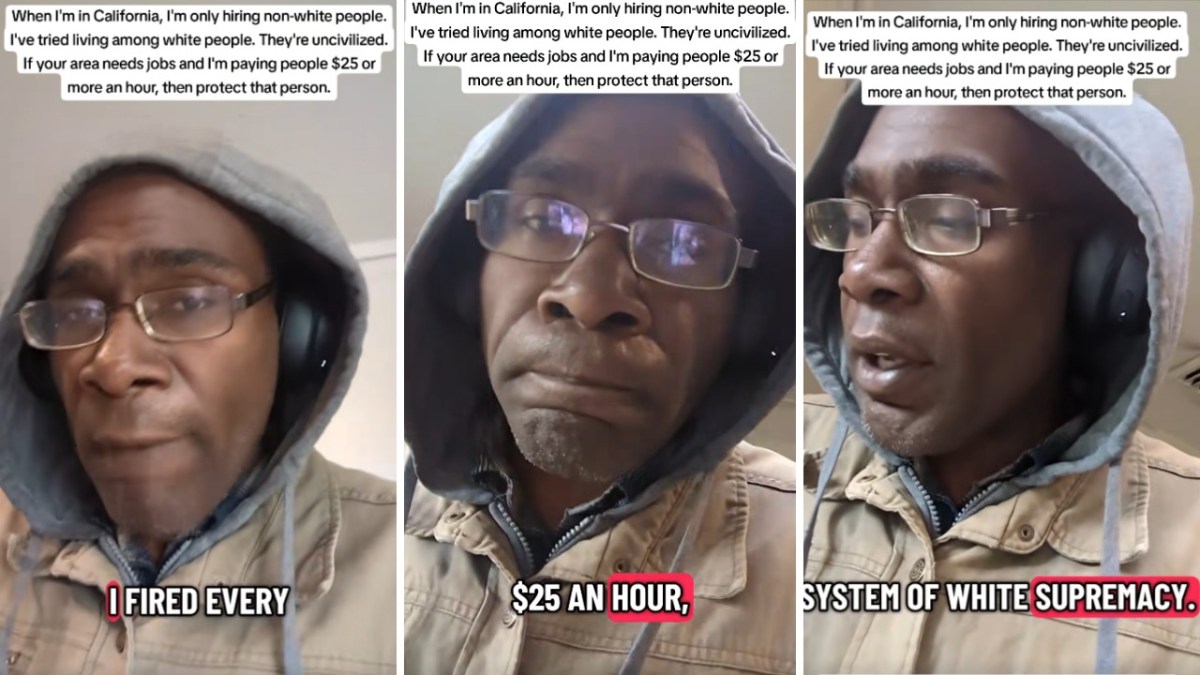

A Black business owner in Roseburg, Oregon, claims that he fired his entire staff of more than 20 white employees. He says the decision followed racial harassment of his family. According to The Nerd Stash, the man made the remarks in a video posted to an account called Black Man in the Wilderness. The claims have not been independently verified. He stated that he paid the employees more than $25 an hour.
He also stated that he and his family were targeted by white supremacists in Roseburg, which is in Douglas County. He also claimed that local authorities, including the county sheriff, knew about the harassment and failed to act. Of firing his staff, he stated that he would “punish the whole town.” He added that he plans to move to California, “where I’m actually appreciated.” He ended his remarks by advising other Black business owners to “let your white employees go.”
Roseburg is the county seat of Douglas County and had 23,683 residents in the 2020 census. The figures list 85.1 percent of residents as white and 0.5 percent, or 130 people, as Black or African American. The city requires registration from anyone who provides a service, product or trade within city limits. The fee is a one-time $150 as long as the ownership and location of the business stay the same.
Business rules and what the law says
At the state level, businesses register with the Secretary of State’s Corporation Division through the Oregon Business Registry. The state advises owners to check that a business name is available before filing. Federal law, under 42 U.S.C. § 2000e-2(a)(1), makes it unlawful for an employer “to discharge any individual” because of “race, color, religion, sex, or national origin.”
The Equal Employment Opportunity Commission (EEOC) lists “hiring, firing, pay, job assignments, promotions” among the areas the law covers. The agency also states that discrimination can occur even when the victim and the person responsible share the same race. The law covers employers with 15 or more employees for at least 20 weeks in the current or preceding calendar year.
In a 9-0 decision in 2025, the U.S. Supreme Court ruled in Ames v. Ohio Department of Youth Services. It held that the standard for a Title VII claim does not change depending on whether a plaintiff belongs to a majority group. Oregon has its own rule. ORS 659A.030 makes it unlawful for an employer to “bar or discharge the individual from employment” because of race, and it applies to employers with one or more employees.
Employment in Oregon is generally at-will, meaning an employer can end it for many reasons, but at-will employment does not override those protections. Whether any of these laws applies would depend on facts that have not been confirmed, including the size of the business and the reasons for each firing. He claimed that his staff understood his decision, which cannot be verified.
The harassment he describes would fall under a separate set of laws, as in a recent case in which a woman was accused of screaming racial slurs at EMS workers. Oregon’s bias crime statute, ORS 166.155, covers acts such as intentionally alarming a person by threats because of their perceived race. It is a Class A misdemeanor.
The statute for more serious cases, ORS 166.165, makes causing physical injury because of a person’s perceived race a Class C felony.













Published: Oct 28, 2026 04:51 pm