


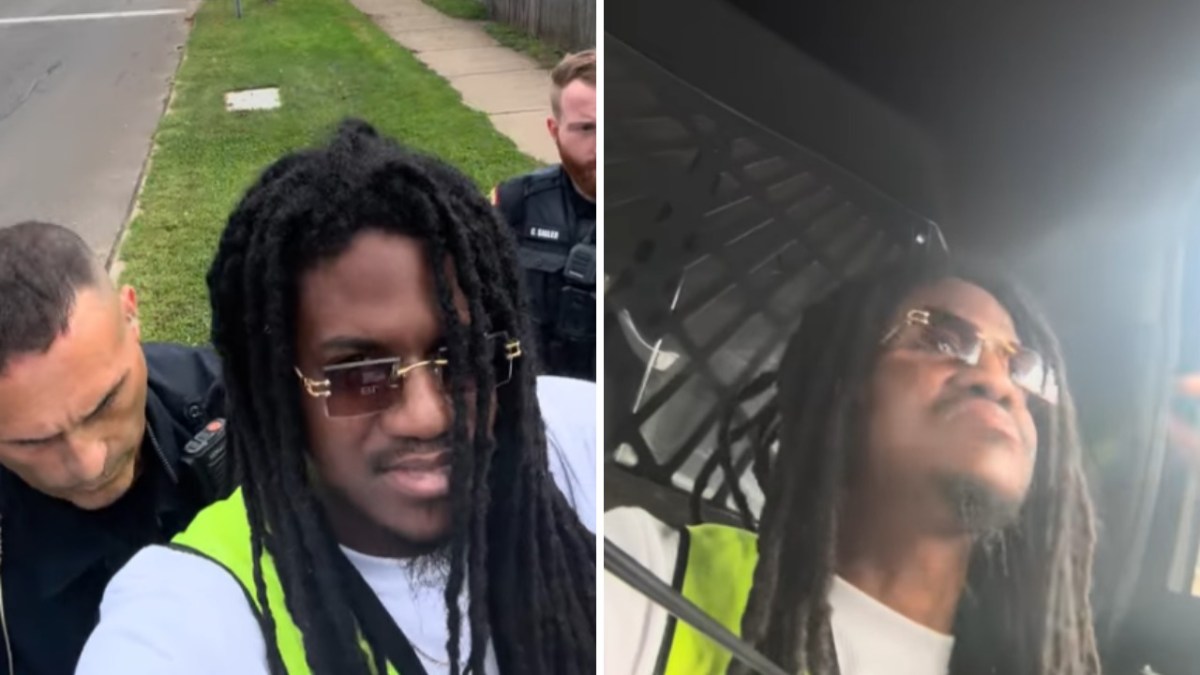

According to Atlanta Black Star, a Barberton, Ohio, police sergeant stopped Vincent White, a Black man aged 32, on Sept. 10 after pointing to the yellow vest he wore. White was arrested and charged with failing to disclose his personal details, a charge the outlet traces to court records available online. The report relies on White’s video and those records, and it does not include a response from the Barberton Police Department.
In the video as described by the outlet, White tells Sgt. Michael Casey that he did nothing wrong and is on the corner for the bus. “Sir, you’re wearing a gas and power thing identifying yourself,” Casey says. “I’m investigating whether or not you’re soliciting in a town that has …” White answers that he is not soliciting. Casey tells him, “Then I’ll identify you and you’ll be on your way.” White does not identify himself and asks why he is being asked, and Casey says, “OK. You are not free to go.”
The outlet says Casey then frisked him for weapons, took an ID out of his wallet, then put him in the rear seat of the cruiser. From the cruiser, White says, “You must be bored today, Black guy waiting on the bus, let me stop him.” Casey responds, “For doing something suspicious in the city of Barberton.” The outlet says Casey has served on the Barberton force since 2014.
What the law says about the stop
Barberton’s solicitation ordinance bars entering residential property to solicit commercially unless a person has registered credentials with the police chief. According to the outlet, White was not charged under it. The online records leave out how long he was held. White uploaded the footage to YouTube the same day, the report says, and the case is still pending, with a hearing set for Oct. 28.
Under Ohio Revised Code § 2921.29, a person in a public place cannot refuse to give a name, address or date of birth when asked by an officer who reasonably suspects that the person “is committing, has committed, or is about to commit a criminal offense,” or that the person witnessed certain serious crimes. The law says that “Whoever violates this section is guilty of failure to disclose one’s personal information, a misdemeanor of the fourth degree.”
It also states that “Nothing in this section requires a person to answer any questions beyond that person’s name, address, or date of birth.” In Terry v. Ohio, a 1968 U.S. Supreme Court decision, the Court held that an officer may stop a person on reasonable suspicion and conduct a limited pat-down if the officer reasonably believes the person is armed and presently dangerous.
Cornell’s Legal Information Institute describes reasonable suspicion as a standard that “demands more than an unparticularized hunch.” In Hiibel v. Sixth Judicial District Court of Nevada, decided in 2004, the Court held that a state may require a person to give a name during a lawful stop. Whether this stop met those standards is not something the report settles, and White is presumed innocent unless proven guilty.






Published: Oct 3, 2026 10:33 am