


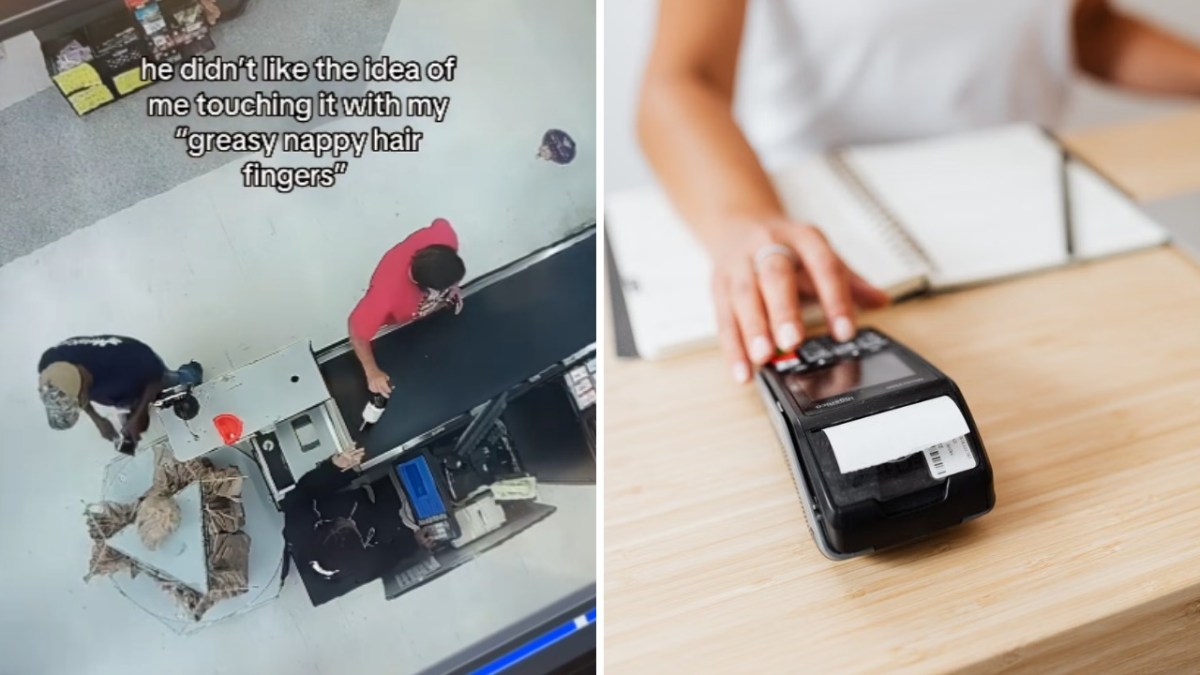

A Black cashier at a Louisiana store says a customer refused to let her handle his bottle of wine and made a racist remark about her hair and hands, according to The Nerd Stash. She posted surveillance footage of the encounter on TikTok. The video shows the man approaching with a bottle of wine, then appearing reluctant to let go of it when the cashier reached for it; both held it briefly before she released her grip.
He moved the bottle over the checkout equipment himself, she took it from him again, and before she could finish processing it, he took it back and walked away. The footage has no audio, so what was actually said between them isn’t captured on the video itself.
The cashier alleged the man said he “didn’t like the idea of me touching it with my ‘greasy nappy hair fingers.'” She said he then bought a different bottle at another register. She has said he’s a regular customer and that this wasn’t the first issue he’d allegedly caused at the store, and that other staff didn’t feel the incident needed to be escalated further.
What the law actually requires from an employer here
Under Title VII of the Civil Rights Act, most federal courts, including the Fifth Circuit, which covers Louisiana, hold employers liable for a customer’s racial harassment of an employee under certain conditions. The employer must have known or should have known about it, and failed to take prompt action to address it.
That standard applies to whether the business bears responsibility, not to whether the customer’s remark itself was illegal. There’s generally no law barring a customer from saying something offensive to a worker, only laws governing how an employer must respond once it’s aware. Courts have generally held that a race-based hostile work environment claim doesn’t always require repeated conduct.
In some circumstances, even a single sufficiently severe racial remark directed at an employee can support a claim, unlike lower-severity conduct, which typically has to happen repeatedly to count. The cashier’s own account that staff didn’t view the incident as needing escalation would be directly relevant to that legal question, if it were ever raised formally. A negligence-based claim turns on the employer’s response once informed, not on the customer’s underlying conduct alone.
None of the parties involved have been named, and the incident’s audio, which would confirm what was actually said, has not surfaced publicly.



Published: Sep 25, 2026 05:30 pm