


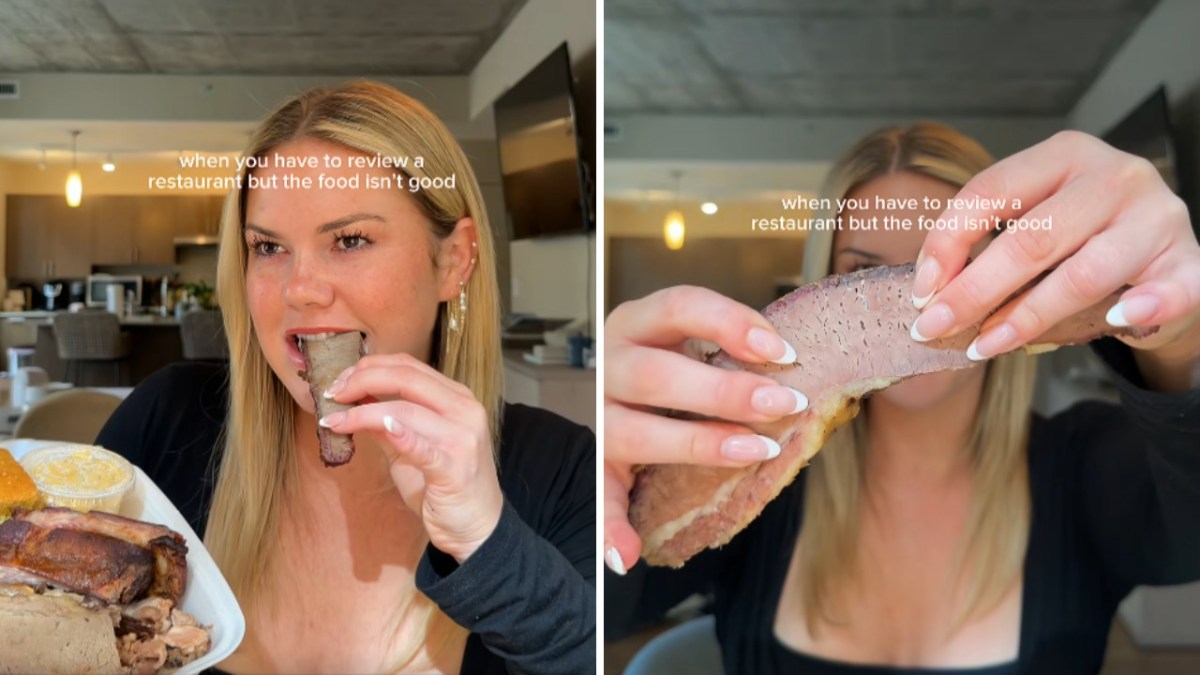

A TikTok video from Bethany Learmont shows her holding up a dry, pale brisket and struggling to tear it apart, the meat eventually ripping with an audible sound she compared to Velcro, according to BroBible. On-screen text reads, “When you have to review a restaurant but the food isn’t good.” Learmont then attempts to chew a bite on camera, visibly struggling.
In her caption, she called the meat “funky,” adding, “As a Texas, this brisket scared me.” She later added that biting into it was “a risk… that I immediately regretted,” and joked about the “Velcro meat” herself. The outlet stated it emailed Learmont for comment. Some commenters became convinced the brisket wasn’t real meat at all. “That’s definitely 3D printed steak,” one wrote.
According to barbecue site How Low Can You Slow, a properly cooked brisket should have a dark mahogany or nearly black bark that’s thick and firm without being hard, and pencil-thick slices; cutting it thinner than that is often a sign the cook was compensating for undercooked, overly firm meat.
What actually tells you a brisket is done
The site describes two physical checks for doneness: a bend test, where a hanging slice should sag without breaking, and a pull test, where two ends should separate with only slight resistance. The tough, dry texture and Velcro-like tear Learmont describes suggest a brisket that would fail both tests.
That texture traces to collagen, a connective tissue that runs heavily through brisket because of where the cut sits on the animal. Collagen begins converting into gelatin, the substance that makes properly smoked meat tender and moist, starting around 160 degrees Fahrenheit, but that conversion takes hours, not just heat. A brisket pulled off the smoker before that process finishes can register as done on a thermometer while its collagen remains largely intact.
The 3D-printed theory isn’t as far-fetched as it sounds as a general concept, even if unlikely here. Companies like Redefine Meat and Novameat have spent years developing plant-based steaks built by layering purees through a printer to mimic real muscle fiber, and Aleph Farms has combined 3D printing with lab-grown animal cells to produce cultivated steak.
None of these products are standard at Texas barbecue restaurants, and nothing in the video suggests the brisket was anything other than real, poorly cooked meat. Texas is a fitting place for this to go viral. Central Texas-style brisket, smoked low and slow with a simple salt-and-pepper rub, is widely considered the state’s signature barbecue style and the benchmark against which brisket elsewhere in the country is often judged, which may explain why Learmont, by her own description a Texan, reacted the way she did.
None of that is a food-safety issue on its own. Restaurant brisket falls under two separate USDA systems that don’t actually govern taste or texture. The USDA’s Food Safety and Inspection Service sets a minimum safe internal cooking temperature for beef, which every restaurant must meet regardless of how the meat turns out.
Separately, the USDA’s voluntary quality grading system, which sorts beef into tiers like Prime, Choice and Select based on marbling and the animal’s age, has nothing to do with how a kitchen actually cooks the cut once it’s purchased; a Prime-grade brisket can still turn out dry and tough if it’s pulled off the smoker too early or rested improperly.





Published: Sep 22, 2026 03:58 pm