


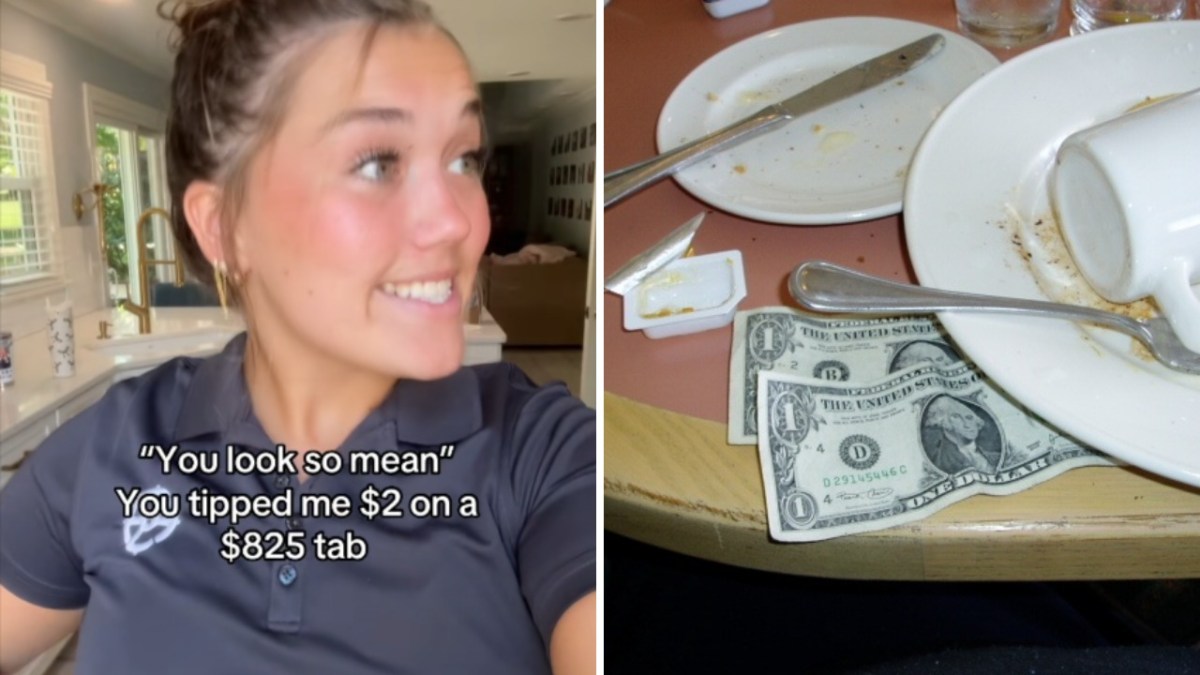

A server says a customer left her a $2 tip on an $825 tab, according to the Daily Dot. In a TikTok, she appears in her work uniform while on-screen text says the customer told her, “You look so mean.” That report says the exchange could not be independently verified, so the details reflect her own account. Her identity, employer and location, along with the customer, remain unconfirmed.
In a later video, she lists her monthly expenses: car payments, car insurance, car maintenance and gas to get to her workplace. “And maybe I’ve lost a plot,” she says. She describes the cycle repeating every month. “It’s just a circle,” she says. “I’m not understanding.” Pay for tipped workers is covered by the U.S. Department of Labor’s Fact Sheet #15.
An employee counts as tipped if they customarily and regularly receive more than $30 a month in tips. An employer can pay a tipped worker a direct cash wage as low as $2.13 an hour, with a tip credit of up to $5.12 an hour making up the gap to the $7.25 federal minimum wage. A worker is tipped only for hours spent in a tipped occupation such as serving, so no tip credit can be taken for hours spent in a different job, such as maintenance work.
Employers must make up any pay below $7.25 an hour
Tips plus the direct wage must reach $7.25 an hour in each workweek. If they fall short, the employer must make up the difference. Before taking a tip credit, an employer must tell tipped employees about it, either orally or in writing, including the cash wage being paid and that the credit cannot exceed the tips actually received.
The tips belong to the worker. Federal law prohibits employers from keeping any portion of them, though employers may require workers to share tips through a pool with other eligible employees, and managers and supervisors cannot take from that pool. When a customer pays the tip by card, the employer may subtract only the card company’s transaction fee on that amount.
A mandatory charge for service, such as a set percentage of the bill, is not considered a tip under the federal law. When state law differs from the federal rules, the standard most protective of employees applies, and some states require a higher cash wage or prohibit the tip credit altogether.
Tipping has also been at the center of other recent disputes between customers and businesses, including a Los Angeles restaurant receipt that paired a $9.28 fee, equal to 16% of the food total, with a note saying the restaurant does not accept tips, though its website says the charge is not a gratuity, and a delivery order where an Alabama customer says a driver added a $10 tip himself, a charge Domino’s later refunded.








Published: Oct 10, 2026 11:48 am