


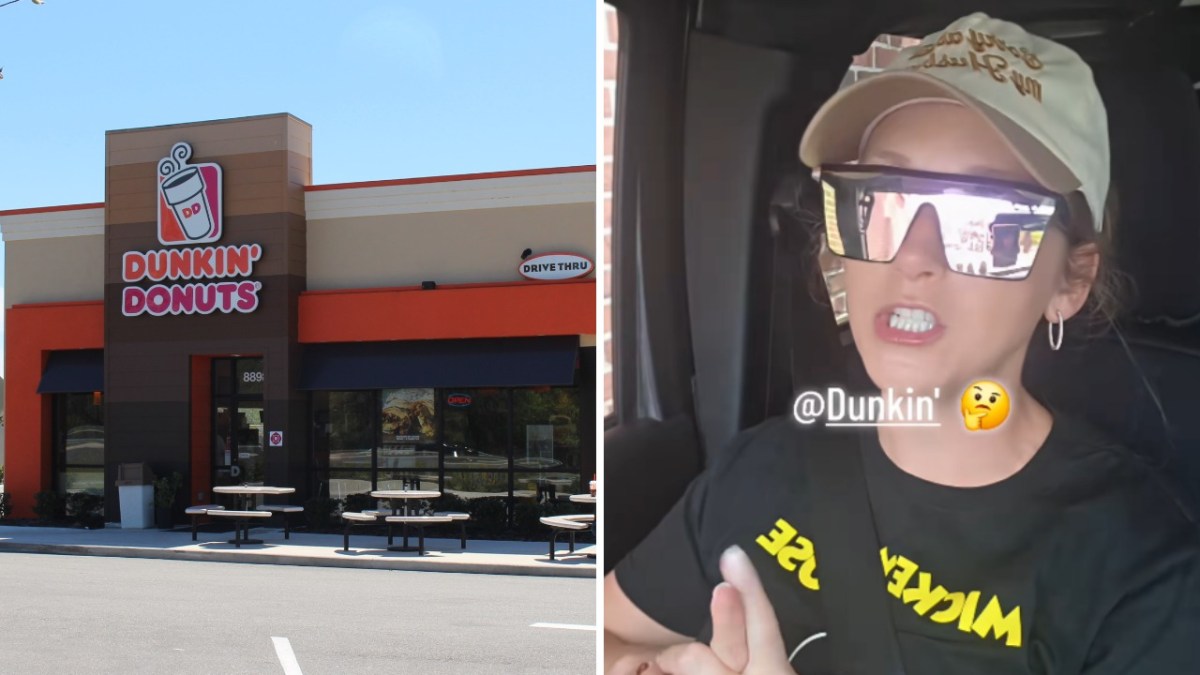

A woman driving away from a Dunkin’ drive-thru is heard telling the camera she’s still confused about what just happened. A friend had introduced her to Dunkin’ lattes and she’d grown “obsessed” with them, she says, so she ordered two, and the worker never gave her a total, according to BroBible, which cited a TikTok video posted by user @yourticktocksister.
She says the worker quoted her 50 cents when she finally requested a receipt. “Sir, wait,” she says. “Dunkin’ Donuts, is this correct? This cannot be correct. I’m confused. Is this proper protocol for here? Because if that’s the case, I’m high-tailing it back to Tim Hortons, and I’m not putting up with this. Because at the very minimum, if I’m spending $14 on two drinks, I want 25 points on Fetch for my receipt; is this correct?”
The outlet emailed both the TikToker and Dunkin’, and its own search turned up nothing suggesting Dunkin’ customers are ever required to pay for a receipt. The outlet has reported similar complaints before, including one where a customer was charged extra without any explanation at checkout. These add-on charges tend to surface only after the fact, once someone actually looks at their receipt or bank statement. By then, the money’s already moved.
This isn’t the first strange charge Dunkin’ customers have flagged
Josh Melton, posting as @imjoshmelton, said he was charged $25.80 at a Dunkin’ drive-thru and paid without questioning it. Only afterward did he notice a line item on the receipt: “What is this right here? Charged tips? $5.16 for charged tips? I didn’t tip anyone anything. Why was I charged that?” He says the store refunded him $5.16 in cash once he raised it, though he had no way to know how many other customers might have been charged the same way without noticing.
There’s no federal or state law requiring a business to charge a fee for handing over a receipt, and no general rule against it either; pricing for incidental services like that is typically left to the merchant. Unauthorized tips or add-on charges sit on different legal footing. If a charge like that lands on a credit card, it can qualify as a billing error under the Fair Credit Billing Act, 15 U.S.C. § 1666, which covers a charge added to an account that the cardholder never authorized.
A cardholder who disputes it in writing within 60 days can force the creditor to investigate, and a merchant found to have added an unauthorized charge risks the card network reversing it through a chargeback. On a debit card, the same kind of dispute falls instead under the Electronic Fund Transfer Act, which carries its own separate rules and deadlines.
If a store simply refuses to make a customer whole after an unauthorized charge like this, the dispute doesn’t have to end there. Small claims filing fees typically run $30 to $75 for a claim this size, though they can climb higher depending on the state, and a winning plaintiff generally recovers that fee as part of the judgment.
A complaint to the state attorney general’s consumer protection division is another route; those offices routinely field exactly this kind of billing complaint against national chains and can pressure a company to respond even without a lawsuit. Filing a dispute directly with the card issuer costs nothing and moves faster than either option.



Published: Sep 16, 2026 01:53 pm